Meta Title: Oil-Free vs Oil-Injected Air Compressors: Pros, Cons & Selection Guide
Meta Description: Compare oil-free and oil-injected air compressors. Learn their advantages, disadvantages, applications, and how to choose the right compressed air system for your factory.
URL Slug: /oil-free-vs-oil-injected-air-compressors
Focus Keyword: oil-free vs oil-injected air compressors
Secondary Keywords: oil-free air compressor, oil-injected air compressor, industrial air compressor, compressed air system, screw air compressor
Introduction
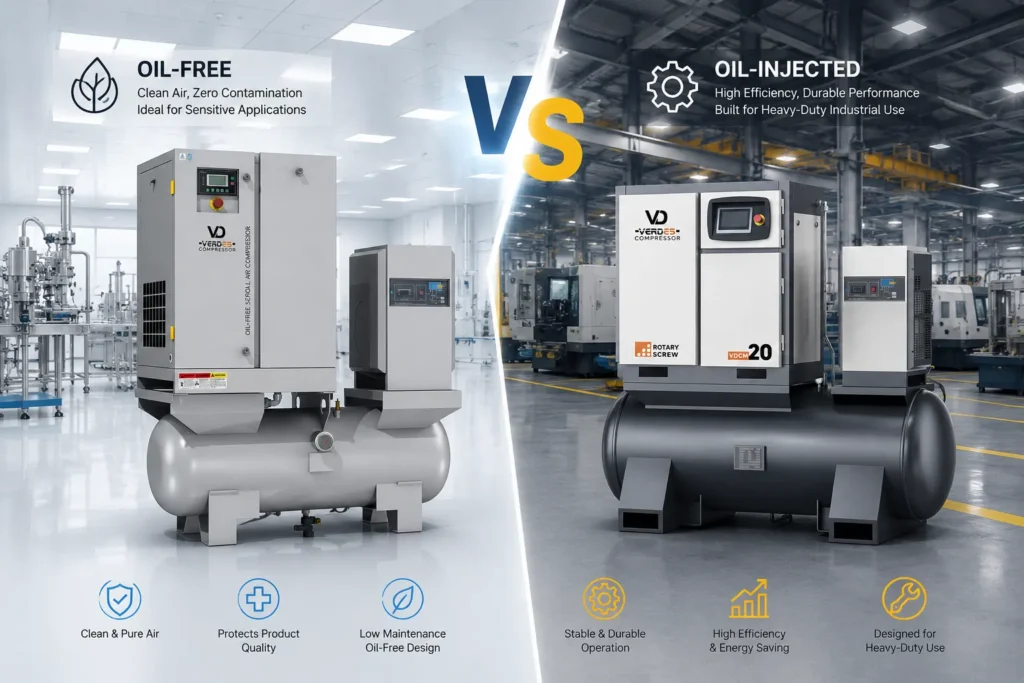
When choosing an industrial air compressor, one of the most important decisions is whether to use an oil-free air compressor or an oil-injected air compressor. Both technologies are widely used in manufacturing, but they are designed for different priorities.
Oil-free compressors focus on clean compressed air and contamination control. Oil-injected compressors are known for stable performance, strong durability, and cost efficiency in general industrial use. Understanding the pros and cons of each type can help factories reduce operating risks, control maintenance costs, and select the most suitable compressed air system.
What Is an Oil-Free Air Compressor?
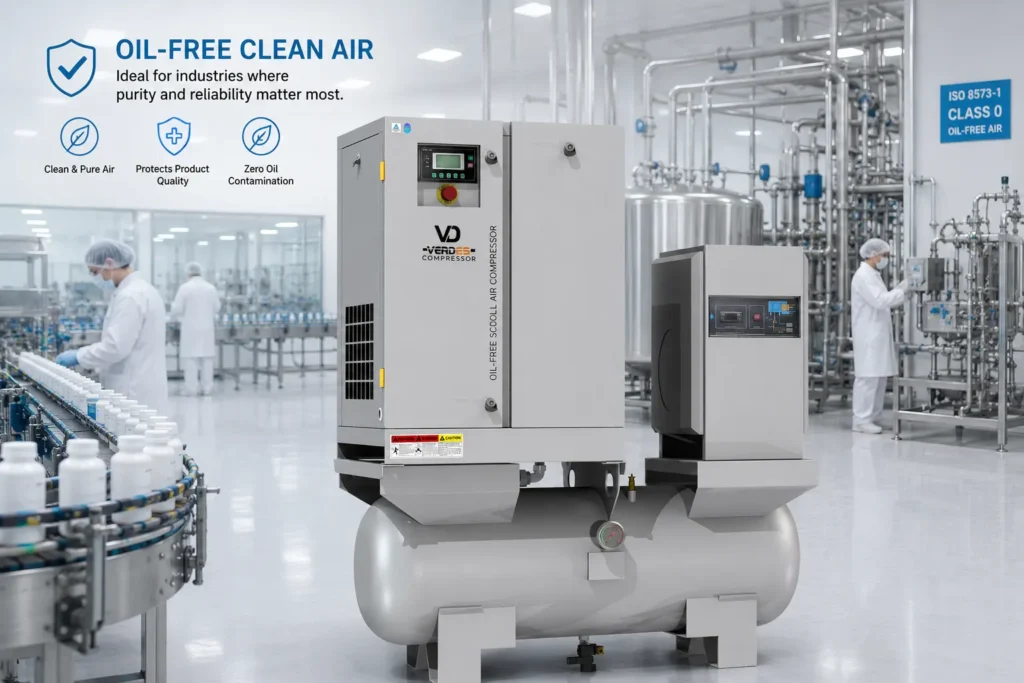
An oil-free air compressor is designed so that oil is not used inside the compression chamber. This helps reduce the risk of oil contamination in the compressed air. It is often selected for industries where air quality directly affects the final product, production process, or safety standard.
Common applications include:
- Food and beverage production
- Pharmaceutical manufacturing
- Electronics and semiconductor production
- Medical and laboratory use
- Textile and high-cleanliness processes
- Packaging lines where air contacts products
Oil-free does not mean the complete system needs no maintenance. Filters, dryers, drains, and pipework still need proper design and regular service. However, the compressor itself is built to minimize oil carryover from the compression process.
Pros of Oil-Free Air Compressors
1. Cleaner Compressed Air
The biggest advantage of oil-free compressors is the reduced risk of oil contamination. For sensitive industries, even a small amount of oil in the air line may cause product defects, quality complaints, or production losses.
2. Better Choice for Critical Applications
If compressed air comes into direct or indirect contact with food, medicine, electronic components, or precision products, an oil-free compressor is often the safer choice. It supports stricter air quality requirements and helps factories meet clean production standards.
3. Lower Risk of Product Contamination
Oil contamination can damage final products, affect coating quality, or create hygiene concerns. Oil-free technology helps protect the production process and reduces the chance of costly rework.
4. Easier Compliance for Clean Air Requirements
For factories that need high air purity, starting with an oil-free compressor makes system design simpler. It can reduce dependence on multiple oil-removal stages and make air quality control more reliable.
Cons of Oil-Free Air Compressors
1. Higher Initial Investment
Oil-free compressors usually cost more than oil-injected models. The technology, materials, and manufacturing precision required are more demanding, so the purchase price is often higher.
2. More Careful System Design Required
Although the compressor does not inject oil into the compression chamber, the whole compressed air system still needs correct filtration, drying, drainage, and pipe layout. Poor system design can still lead to moisture, particles, or external contamination.
3. Not Always Necessary for General Industrial Use
For applications such as pneumatic tools, general machining, workshop air, tire inflation, and many standard factory processes, oil-free air may not be required. In these cases, the higher investment may not bring enough practical value.
What Is an Oil-Injected Air Compressor?
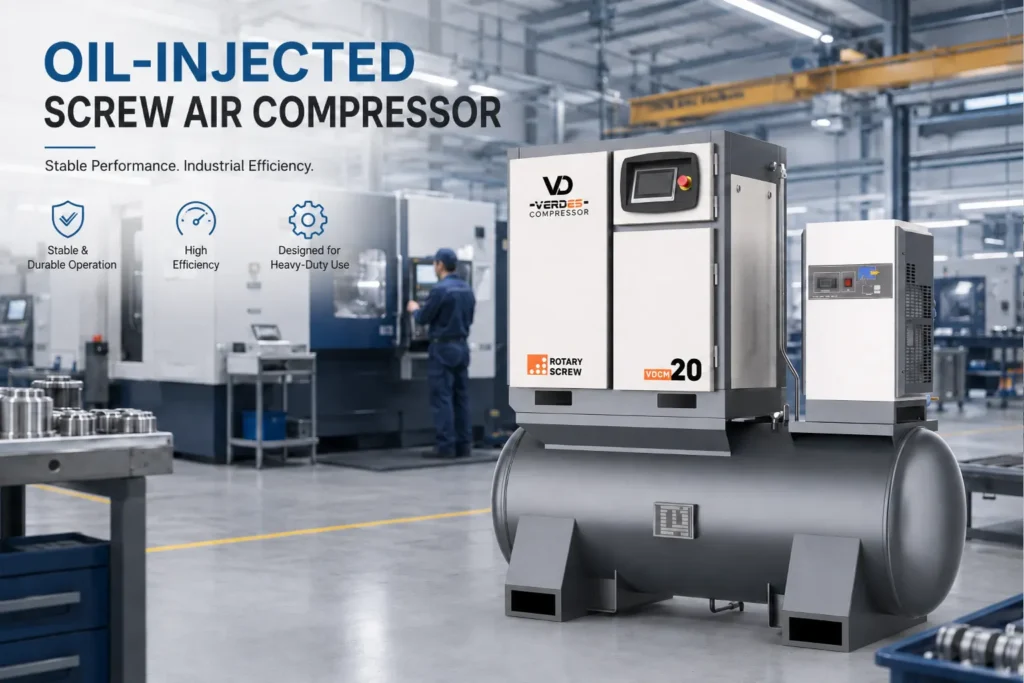
An oil-injected air compressor uses oil inside the compression chamber for lubrication, sealing, and cooling. This is one of the most common technologies for industrial screw air compressors.
The oil helps improve compression efficiency, reduce internal wear, and control operating temperature. After compression, an oil separator removes most of the oil from the air before it enters the downstream system.
Common applications include:
- CNC machining
- Metal fabrication
- Auto repair workshops
- Pneumatic tools
- Packaging machinery
- Textile production
- General manufacturing
- Plastic, woodworking, and assembly lines
Pros of Oil-Injected Air Compressors
1. Cost-Effective for Most Factories
Oil-injected compressors usually have a lower purchase cost than oil-free models. For many industrial users, they offer a strong balance between price, performance, and reliability.
2. Stable and Durable Operation
Because oil provides lubrication and cooling, oil-injected screw compressors are well suited for continuous industrial operation. They are widely used in factories that need stable air supply for long working hours.
3. Good Energy Efficiency
Modern oil-injected screw compressors, especially models with permanent magnet motors and VSD control, can provide efficient air delivery according to real air demand. This helps reduce energy waste in variable-load applications.
4. Easier Maintenance and Parts Availability
Oil-injected compressors are common in the global market. Spare parts, filters, oil separators, lubricants, and service experience are widely available, making maintenance easier for many users.
Cons of Oil-Injected Air Compressors
1. Oil Carryover Risk
Even with a good oil separator, a small amount of oil may remain in the compressed air. For clean production industries, this may not be acceptable without additional air treatment.
2. Requires Regular Oil and Filter Maintenance
Oil-injected compressors need regular replacement of lubricating oil, oil filters, air filters, and oil separators. If maintenance is ignored, air quality, efficiency, and machine life can all be affected.
3. More Downstream Treatment May Be Needed
For applications requiring cleaner air, oil-injected systems may need refrigerated dryers, adsorption dryers, precision filters, and activated carbon filters. These components add cost and require maintenance.
Oil-Free vs Oil-Injected Air Compressors: Quick Comparison
| Item | Oil-Free Air Compressor | Oil-Injected Air Compressor |
|---|---|---|
| Air Quality | Higher cleanliness, lower oil contamination risk | Suitable for general industrial air |
| Initial Cost | Higher | Lower |
| Maintenance | No compressor oil in compression chamber, but system still needs service | Requires oil, filters, and separator maintenance |
| Best For | Food, pharma, electronics, clean processes | CNC, workshops, tools, general manufacturing |
| System Design | Focus on purity and contamination control | Focus on reliability and cost efficiency |
| Main Advantage | Cleaner compressed air | Strong value and stable performance |
| Main Limitation | Higher investment | Oil carryover risk |
How to Choose the Right Compressor
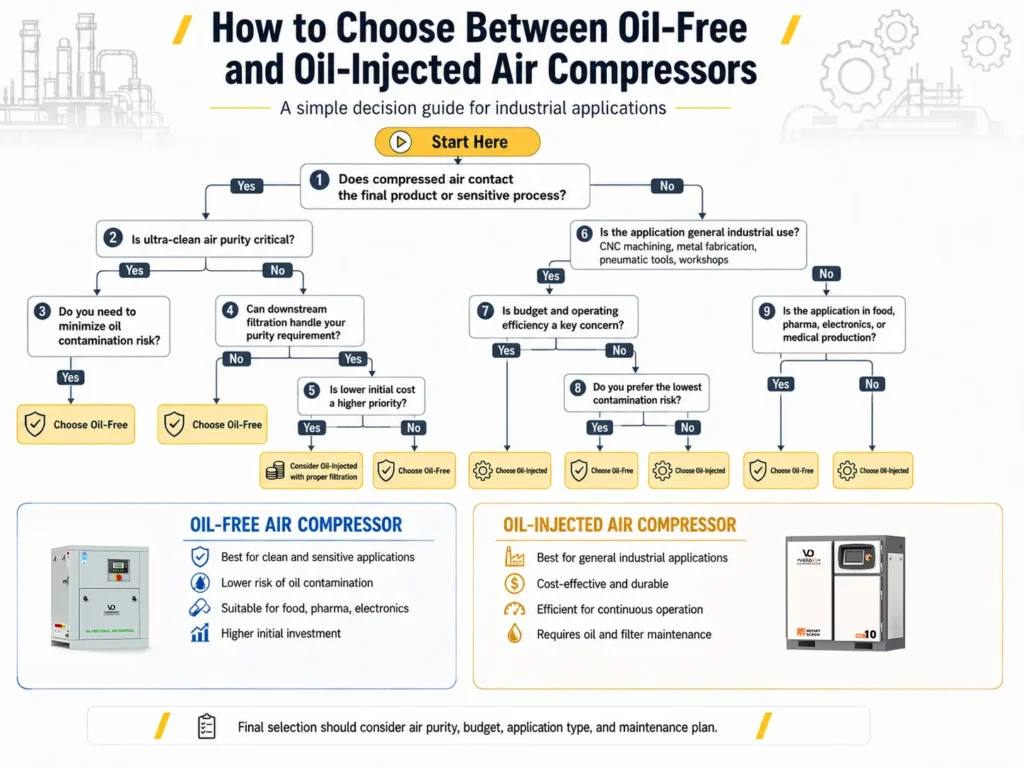
Choose an oil-free air compressor if your production process requires very clean air or if compressed air may contact sensitive products. It is a better option for food, medicine, electronics, laboratories, and other high-purity applications.
Choose an oil-injected air compressor if your factory mainly needs reliable power for machines, tools, and general production lines. It is usually more economical and practical for standard industrial applications.
Before making a decision, consider these questions:
- Does compressed air contact the final product?
- What air quality class does your process require?
- Is oil contamination a serious risk?
- What is your budget for purchase and maintenance?
- Do you need continuous operation or variable air demand?
- What dryers and filters will be used downstream?
Conclusion
There is no single best choice for every factory. Oil-free and oil-injected air compressors each have clear advantages.
Oil-free compressors are ideal when air purity and contamination control are the top priorities. Oil-injected compressors are more cost-effective for most general industrial applications and offer strong reliability for daily production.
For the best result, choose the compressor based on your industry, air quality requirement, working pressure, air flow demand, and long-term operating cost. A properly selected compressed air system can improve production stability, reduce maintenance problems, and protect your equipment.
Need help choosing the right compressor for your factory? Contact VD Compressor for a professional compressed air solution based on your application, pressure, and air flow requirements.