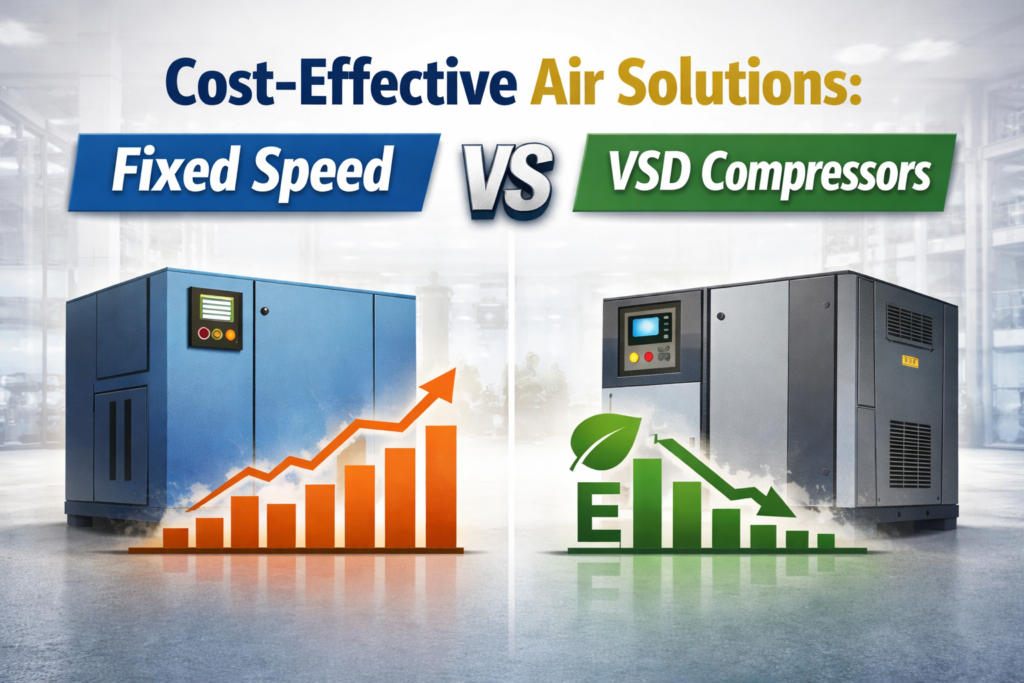
When it comes to selecting the right air compressor for your business, cost-effectiveness is one of the most When it comes to selecting the right air compressor for your business, cost-effectiveness is one of the most important factors to consider. Whether you’re a small business or a large industrial operation, choosing between fixed speed and variable speed drive (VSD) compressors can significantly affect both your initial investment and long-term operational costs. This article will compare both compressor types based on cost, energy efficiency, and long-term savings, providing you with the insights needed to make the best decision for your needs.
1. Introduction
Air compressors are a critical part of operations across various industries, providing the necessary compressed air for production, manufacturing, and other processes. However, the selection of the right compressor goes beyond just purchasing the most affordable option. Energy efficiency, long-term costs, and the ability to scale with demand are all key factors in ensuring that your compressor investment aligns with your operational goals.
In this article, we compare Fixed Speed and Variable Speed Drive (VSD) compressors to help you understand which option offers the best balance of cost and efficiency for your business.
2. Understanding the Basics of Air Compressors
Before diving into cost comparisons, it’s important to understand the basic operations of fixed speed and VSD compressors.
- Fixed Speed Compressors: As the name suggests, fixed-speed compressors run at a constant speed regardless of demand. They are reliable and simple, typically used in applications where air demand is steady.
- VSD Compressors: Unlike fixed-speed models, VSD compressors can adjust their speed according to the air demand. By dynamically changing the motor speed, VSD compressors are more energy-efficient, especially in applications with varying air demand.
3. Cost-Effectiveness of Fixed Speed Compressors
Initial Investment
Fixed-speed compressors are generally less expensive than VSD models in terms of initial purchase price. Their simple design and lack of sophisticated controls contribute to lower upfront costs. This makes them a more budget-friendly option for businesses with limited initial investment budgets.
Energy Consumption
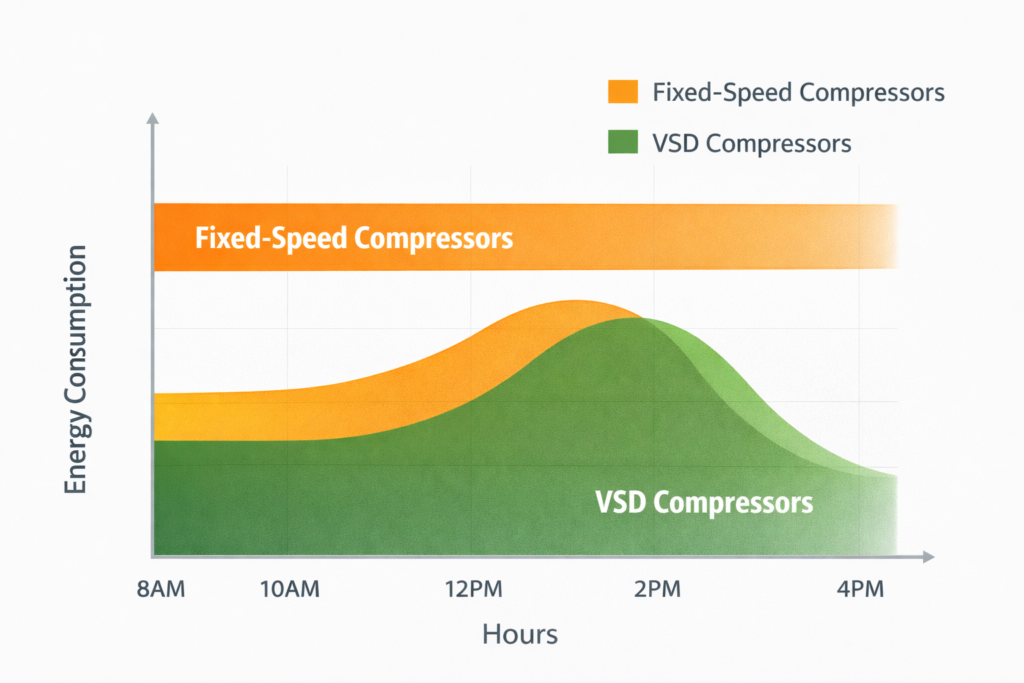
However, the primary drawback of fixed-speed compressors is their constant energy consumption. Since they run at full capacity all the time, even when air demand is low, energy efficiency suffers. As a result, companies often experience higher energy bills over the long term, especially in industries where air demand fluctuates.
Maintenance and Operating Costs
Fixed-speed compressors tend to have lower maintenance costs compared to VSD compressors. With fewer moving parts and simpler mechanics, maintenance is straightforward, which can be appealing for businesses looking to minimize downtime and repair costs.
However, because fixed-speed compressors operate at full power continuously, they tend to wear out faster and may require more frequent maintenance in high-demand environments.
Suitable for:
Fixed-speed compressors are ideal for businesses with a constant and predictable air demand, such as small workshops or businesses with limited usage cycles.
4. Cost-Effectiveness of VSD Compressors
Initial Investment
While VSD compressors come with a higher initial investment due to their advanced control systems and motor technology, the potential for energy savings can offset these upfront costs over time. VSD compressors are typically 20-30% more expensive than their fixed-speed counterparts.
Energy Efficiency Benefits
The most significant advantage of VSD compressors is their ability to adjust to varying air demands, leading to significant energy savings. By running at lower speeds during periods of low demand, VSD compressors consume only the energy required for the task at hand, avoiding the waste associated with fixed-speed models. This efficiency can drastically reduce energy bills over the long term.

Maintenance and Operating Costs
Although VSD compressors tend to have higher maintenance costs due to the complexity of their systems, the long-term savings on energy consumption often outweigh these additional costs. With less wear and tear on the motor, VSD compressors typically have longer lifespans than fixed-speed models, reducing the frequency of repairs and replacements.
Suitable for:
VSD compressors are best suited for industries where air demand fluctuates or where efficiency and energy savings are top priorities. These include industries such as manufacturing, pharmaceuticals, and food processing, where the need for compressed air varies throughout the day.
5. Initial Investment vs. Long-Term Operational Costs
Comparing Purchase Prices
Fixed-speed compressors typically have a lower purchase price, which can be appealing if you’re working within a tight budget. However, VSD compressors are an investment in the future. The higher upfront costs are compensated by the savings you will see in reduced energy consumption.
Total Cost of Ownership (TCO)
The total cost of ownership includes not only the initial purchase price but also ongoing operating costs. VSD compressors shine in this category, with their ability to adjust energy use based on demand. In contrast, fixed-speed compressors tend to accumulate higher energy costs over time, making them a less efficient choice for businesses with fluctuating air needs.
6. Deciding on the Right Air Compressor for Your Needs
When choosing between fixed-speed and VSD compressors, consider the following factors:
- Air Demand: Is your air usage constant, or does it fluctuate throughout the day? If air demand is relatively steady, a fixed-speed compressor might be sufficient. However, if your demand varies, a VSD compressor could save you significant amounts in energy costs.
- Budget: If you’re looking to minimize initial investment costs, a fixed-speed compressor may be the best choice. However, if you’re looking for long-term savings, a VSD compressor might justify its higher initial cost.
- Energy Efficiency: For businesses looking to reduce their environmental impact and energy bills, VSD compressors offer a clear advantage, especially in industries with varying air demands.
7. Case Studies: Real-World Examples
- Fixed Speed Air Compressor in Action: In a small manufacturing plant with consistent, steady air demand, a fixed-speed compressor is providing reliable performance while keeping upfront costs low. While energy consumption is higher, the business finds that the simplicity of the fixed-speed compressor outweighs this downside.
- VSD Air Compressor in Action: A large-scale food processing plant invested in VSD compressors. By adjusting their speed to meet changing production demands, they reduced energy consumption by over 30%, leading to significant cost savings over a year.
8. Conclusion
Selecting the right air compressor involves balancing initial investment costs with long-term operational savings. While fixed-speed compressors are ideal for businesses with stable air demand, VSD compressors provide better energy efficiency and lower operational costs, making them a more cost-effective solution in the long run.
When making your decision, consider your business’s unique needs, air demand patterns, and budget. Choosing the right compressor today can lead to significant savings and increased efficiency for years to come.
For more details on our products and solutions, visit our product catalog or reach out to our sales team for personalized recommendations.